













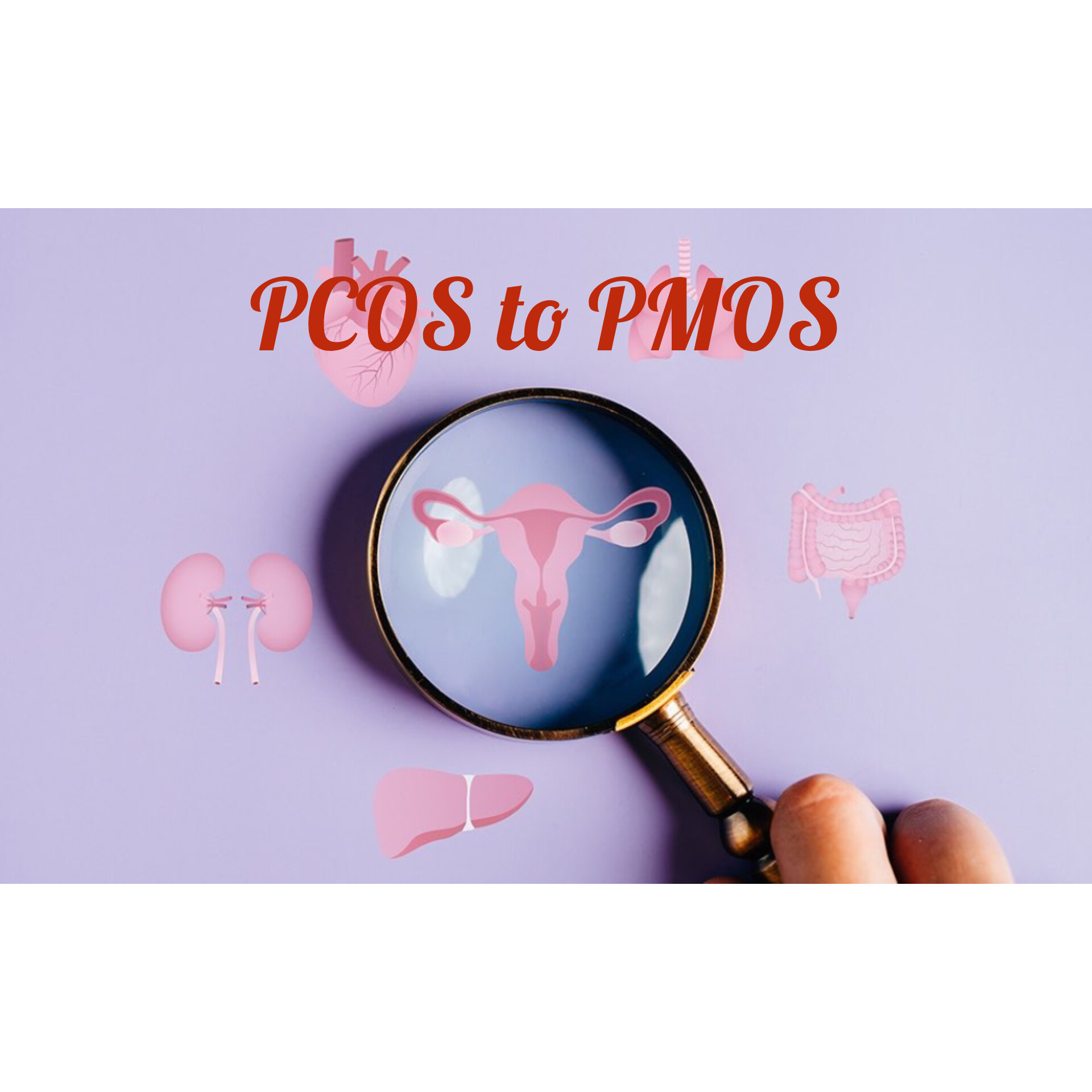
Why PCOS was renamed PMOS?
In 1935, two American doctors examined seven women’s ovaries and saw small lumps. They called them cysts and named the disease after them. They were wrong. It took 91 years to fix.
What we called PCOS is now Polyendocrine Metabolic Ovarian Syndrome (PMOS), announced today in The Lancet by an international panel of doctors and patients. The renaming followed more than a decade of consensus work and 22,000 patient and clinician survey responses.
The lumps Stein and Leventhal saw were never cysts. Modern imaging shows they were follicles, the tiny sacs inside the ovary that grow and release an egg each month, frozen partway through by a hormonal imbalance. PMOS is a multi-system disorder centered in the endocrine system, the body’s network of glands that produces hormones like insulin (controls blood sugar), cortisol (the stress hormone), and thyroid hormones (set the body’s metabolism). The ovary trouble flows downstream from there.
The naming choice is not academic. When doctors hear “ovary” in a diagnosis, they look at the ovary. “Metabolic” and “endocrine” send them to the whole body.
PMOS affects roughly 1 in 8 women worldwide, more than 170 million people. The WHO estimates 70% have never been diagnosed. Among those who do, 1 in 3 wait more than 2 years, and nearly half see 3 or more doctors first. The CDC reports more than half of women with PMOS develop type 2 diabetes by age 40, a risk 5 to 10 times higher than women without the condition. Around 37% have clinically significant depression, compared with 14% in women without it. Anxiety runs at 42% versus 8.5%.
A label born from a 1935 look at seven ovaries is finally going away. The new diagnostic guidelines roll out fully in 2028. By then, a woman walking into a clinic with these symptoms should hear questions about her blood sugar and her mood alongside her cycle. Those are the parts of the disease the old name hid for 91 years.
After 91 years, doctors still don’t have a single drug designed to treat the disease the world just renamed PMOS. The closest treatments they have were built for something else.
PCOS, now officially PMOS, has never had an FDA-approved medication. Every prescription a doctor writes, from metformin to birth control to Ozempic, is off-label. Each drug was developed and tested for a different disease and is borrowed for this one.
The patchwork has been the standard of care for decades. Metformin, the standard type 2 diabetes drug, helps PMOS patients process insulin and blood sugar, while birth control pills are used to mask the hormonal symptoms. Antiandrogens originally developed for prostate cancer get prescribed for facial hair and acne. Together, they treat the symptoms but never the disease.
The biggest shift in PMOS care in 30 years is happening right now, and it is also a hand-me-down. GLP-1 drugs like Ozempic and Mounjaro were built for type 2 diabetes and obesity. In one 2023 study, 80% of obese women with PMOS who had failed lifestyle programs lost weight on low-dose Ozempic, and the same 80% saw their menstrual cycles normalize. Off-label GLP-1 prescriptions for women with PMOS rose 7-fold between 2021 and 2025, from 2.4% of patients to 17.6%.
Research funding is part of the story. Between 2016 and 2022, the NIH averaged $31.8 million per year on PMOS research, while spending $262 million per year on rheumatoid arthritis and $420 million per year on lupus. PMOS affects roughly 170 million people. Lupus affects around 5 million.
In the US alone, PMOS drives more than $15 billion in healthcare costs every year. The next generation of GLP-1 drugs is already in late-stage trials, with a more powerful injectable called retatrutide among them. None of these were developed specifically for PMOS. The disease finally got its name fixed, but it is still waiting for a treatment of its own.
PMOS often shows up on the skin years before any doctor names it. About 70% of women with the disease grow coarse, dark hair in a male pattern on the face and body. Around 40% develop deep, painful acne along the jawline that doesn’t respond to standard treatment. Up to half see their scalp thin like male-pattern baldness. All three are running on the same hormonal engine: an excess of testosterone, which the old name PCOS never captured.
The medical word for it is hyperandrogenism, which means the body producing more “male” hormones than the female system is built for. It is the most consistent feature of PMOS, found in 75 to 90% of women with the disease. The new name keeps it as the disease’s defining hallmark.
For decades, the doctor a woman sees about these symptoms has usually been a dermatologist. That makes some sense at first. Acne, excessive hair, and scalp thinning all show up on the skin, and dermatologists are trained to manage what shows up on the surface.
The dermatologist is often the wrong specialist for the underlying disease. The blood test that flags hyperandrogenism, free testosterone, is rarely run in a dermatology workup. A woman can spend years getting laser hair removal, antibiotics for her acne, and Rogaine for her hair while the disease driving all three goes unnamed and untreated.
The cost of hirsutism treatment alone in the US runs about $622 million a year. Most of this money lands in dermatology offices, while the underlying disease lives in endocrinology.
The signs themselves have been measurable for 65 years. In 1961, two researchers named Ferriman and Gallwey published a scale for scoring excess hair growth across nine areas of the body. A score of 8 or higher signals clinically significant hirsutism and a likely endocrine problem. The test costs nothing and takes minutes. The disease it points to still goes undiagnosed for years.
Most women with PMOS only find out they have the disease when they try to get pregnant. The symptoms have usually been there for ten years. The fertility clinic is where the disease finally gets a name.
PMOS is the single biggest reason women in the world can’t conceive when they want to. About 80% of all anovulatory infertility (the kind where a woman’s body isn’t releasing eggs at all) traces back to the disease. Among women with PMOS, 70 to 80% will face fertility problems at some point. Over a lifetime, more than half struggle to conceive, compared with about 20% of women without it.
Even when pregnancy does happen, it’s statistically harder. Women with PMOS develop gestational diabetes at roughly four to six times the rate of women without the condition. The risk of pre-eclampsia, a sudden and sometimes dangerous spike in blood pressure during pregnancy, runs about two to four times higher. Miscarriage rates and the chance of premature birth are both meaningfully elevated. None of this disappears when the baby is healthy.
The pattern reaches across generations. Twin studies put the heritability of PMOS at around 70%, on par with height. A large family study of nearly 30,000 daughters of women with PCOS found a fivefold increase in the daughter’s own risk of developing the disease compared to daughters of women without it. About 60 to 70% of those daughters end up with the same condition their mother had.
The renaming isn’t a cure. But it’s the first time in 91 years that the name itself tells fertility doctors what kind of disease they’re actually treating. That difference will show up in the kind of pregnancy a woman has, and in whether her daughter ends up sitting in the same clinic 25 years from now.
Women with PMOS face roughly 3 times the lifetime risk of endometrial cancer. About 9% of them will develop the disease at some point, compared with about 3% of women without PMOS. Among women under 50, the risk runs 4 to 6 times higher.
The mechanism comes down to one missing hormone. When a woman ovulates, the ovary releases an egg and then produces progesterone for the second half of the cycle. Progesterone tells the uterine lining to shed at the end of the month. In PMOS, ovulation often fails. Without progesterone, the uterine lining keeps thickening from estrogen alone.
Over years, this unopposed estrogen turns into a problem the body cannot fix on its own. The lining grows beyond its normal cycle, and some of those cells become abnormal. A small fraction of those become cancer.
Endometrial cancer is the most common cancer of the female reproductive system in the United States. A 2014 University College London meta-analysis put PMOS women’s odds at 2.79 times the baseline, rising to 4.05 times higher in women under 54. The same pattern showed up in a 2024 Danish study of 1.7 million women, where the younger PMOS women carried nearly 6 times the baseline risk.
The fix is not exotic. Cyclic progestin or oral contraceptive pills force the lining to shed on a regular schedule, undoing the effect of missing ovulations. A progestin-releasing IUD like Mirena does the same thing locally. Standard endometrial surveillance, a transvaginal ultrasound and sometimes a biopsy, catches abnormal thickening before it becomes cancer. The drugs and the test are decades old and inexpensive.
For 91 years, the disease carried a name that pointed at the wrong organ. The renaming to PMOS finally captures what is actually wrong with the system: a body-wide hormonal imbalance whose long-term cost shows up across the uterus, the pancreas, the heart, and the rest of a woman’s life. Reducing that cost starts with naming the disease correctly. The second piece is more practical: a real period at least four times a year.
Credit: ANISH MOONKA
Thanks for going down this rabbit hole ❤️
Follow @anishmoonka for daily stories across science, history, psychology, culture & AI.
—————
Sources:
STAT News, PCOS now called PMOS — Polyendocrine Metabolic Ovarian Syndrome, May 12 2026
statnews.com/2026/05/12/pco…
Live Science, Goodbye PCOS (Teede et al. 2026 Lancet paper)
livescience.com/health/reprodu…
PR Newswire (University of Colorado Anschutz), Global Experts Establish New Name for PCOS
prnewswire.com/news-releases/…
CDC, Diabetes and Polycystic Ovary Syndrome (>50% develop T2D by age 40)
cdc.gov/diabetes/risk-…
PMC, Anxiety and Depression in Women with Polycystic Ovary Syndrome — meta-analysis (depression 37% vs 14.2%; anxiety 42% vs 8.5%)
pmc.ncbi.nlm.nih.gov/articles/PMC93…